
When a commercial truck tire blows out and causes a crash in El Paso, the legally responsible party depends on why the tire failed and who had the duty to prevent that failure. Liability may involve the truck driver, motor carrier, maintenance company, tire manufacturer, cargo-loading company, equipment owner, or several parties at the same time.
Federal safety rules set minimum requirements for the condition, tread depth, loading, and inflation of commercial truck tires. Texas law can also divide responsibility among several people or companies when more than one party contributed to a crash.
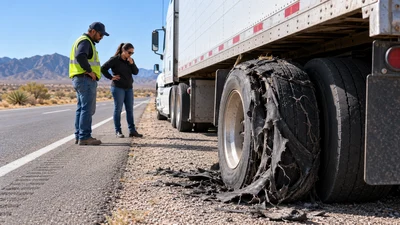
If you were injured in a truck tire blowout accident, evidence such as the failed tire, maintenance records, inspection reports, cargo records, photographs, video, and electronic truck data can help show why the tire failed and who was responsible for the conditions that led to the crash.
A blowout may seem sudden, but the condition that caused the failure can develop over days, weeks, or months. An investigation may reveal poor maintenance, unsafe tire condition, overloading, improper installation, negligent inspection, a product defect, or another cause.
Key Point: A tire blowout does not identify the responsible party by itself. Liability depends on why the tire failed and who controlled the safety decisions connected to that failure.







Why a Truck Tire Blowout Does Not Automatically Identify the Liable Party
A blown tire does not automatically prove that the truck driver or trucking company was negligent. Tires can fail because of underinflation, excessive wear, improper repair, overloading, impact damage, tread separation, manufacturing defects, or other conditions.
The legal question is usually whether a person or company had a duty to keep the truck reasonably safe, failed to meet that duty, and caused or contributed to the collision and your injuries.
Federal regulations set specific requirements for commercial truck tires. A commercial motor vehicle generally may not be operated on a tire with exposed ply or belt material, tread or sidewall separation, a flat condition or audible leak, or a cut that exposes ply or belt material. Front tires on a truck or truck tractor generally must have at least 4/32 inch of tread depth in a major tread groove. Most other covered tires generally require at least 2/32 inch. Federal rules also address tire loading and inflation.
The Truck Driver May Be Responsible
A truck driver may be liable when evidence shows that the driver knew, or reasonably should have known, that a tire was unsafe and continued operating the vehicle.
Federal rules state that a commercial motor vehicle should not be driven unless the driver is satisfied that listed equipment, including tires, wheels, and rims, is in good working order. Federal pre-trip rules also require the driver to be satisfied that the vehicle is in safe operating condition and, when applicable, to review the previous driver vehicle inspection report before driving.
Driver negligence may become an issue when evidence shows that a driver:
- Ignored visible tread separation, sidewall damage, exposed material, or another apparent defect.
- Continued driving after discovering a low or leaking tire.
- Failed to respond to a known tire problem reported during a trip.
- Operated the truck despite a tire condition that made the vehicle unsafe to operate.
- Failed to address a tire defect identified during a required inspection or report.
A driver may not be responsible for a hidden internal tire defect that a reasonable inspection would not reveal. Tire failure cases require investigation rather than assumptions.
For more information about commercial truck claims, see the El Paso Truck Accident Attorneys page:
https://chavezlawfirm.law/el-paso-truck-accident-attorneys/


Enrique Chavez
Texas Trial Attorney
Protecting Your Rights
The Trucking Company May Be Liable for Poor Maintenance
A motor carrier can be responsible when inadequate maintenance, poor inspection practices, or a decision to keep unsafe equipment in service contributes to a tire blowout.
Federal motor carrier rules require carriers to systematically inspect, repair, and maintain vehicles under their control. Covered parts and accessories must be kept in safe and proper operating condition. Carriers must also maintain required inspection, repair, and maintenance records.
In a tire blowout investigation, records may show whether the carrier:
- Tracked tire age, wear, pressure, and condition.
- Followed an inspection and replacement schedule.
- Responded to driver complaints or defect reports.
- Repaired a tire repeatedly when replacement may have been necessary.
- Continued using equipment after a safety problem was identified.
- Maintained records showing when tires were purchased, installed, repaired, rotated, or removed from service.
Those records can help distinguish an unexpected failure from a maintenance problem that may have been preventable.
A Maintenance Company or Tire Shop May Share Responsibility
Trucking companies often hire outside businesses to install tires, perform repairs, retread tires, inspect fleets, and service trailers. If negligent work contributed to the blowout, an outside maintenance company or tire shop may share responsibility.
Potential issues can include:
- Installing an unsuitable tire.
- Performing an improper repair.
- Missing visible damage during an inspection.
- Mounting a tire incorrectly.
- Failing to follow proper inflation or service procedures.
- Returning a tire to service when its condition required removal.
A truck tire blowout case can involve more parties than a typical passenger-vehicle crash because several businesses may have controlled different parts of the truck, trailer, tire, maintenance, or loading process.
For a broader explanation of truck accident claims, see:
https://chavezlawfirm.law/how-truck-accident-claims-differ-from-car-accident-claims-in-el-paso/



– Steve Hendrix
– Adriana Solis
– Luis Amador
– Maria Terrazas
A Tire Manufacturer May Be Liable for a Defective Product
Some tire failures begin with a product defect rather than poor maintenance. Potential problems can include tread separation, structural failure, bonding problems, or another defect that causes a tire to fail during reasonably expected use.
Texas product liability law applies specific requirements to defective-product claims. In a design defect case, Texas Civil Practice and Remedies Code Section 82.005 requires a claimant to prove that a safer alternative design existed and that the alleged defect was a producing cause of the injury, property damage, or death.
Manufacturing defect and inadequate warning claims involve different legal elements. The condition of the actual tire can become critical evidence. Preserving the tire before it is discarded, repaired, altered, or destroyed may be central to determining whether a product defect contributed to the failure.
Chavez Law Firm also provides information about defective-product claims here:
https://chavezlawfirm.law/el-paso-product-liability-attorneys/
A Cargo Loader or Other Company May Be Involved
Commercial truck tires are designed to carry defined loads. When a truck or trailer is overloaded or cargo is distributed improperly, extra stress can be placed on tires, wheels, suspension components, and other equipment.
If an outside shipper, warehouse, loading contractor, or another company controlled the loading process, its conduct may need to be investigated. A trailer owner, leasing company, or other equipment provider may also have maintenance or inspection responsibilities depending on the facts.
More than one company can contribute to the same tire failure. Identifying each potentially responsible party can matter when a crash causes serious injuries, medical expenses, lost income, or long-term limitations.
Why El Paso Driving Conditions Can Matter
El Paso motorists share I-10, US-54, Loop 375, and other major routes with commercial trucks every day. Long highway travel and high temperatures can place additional stress on a tire that is already underinflated, overloaded, damaged, or badly worn.
Heat alone does not establish negligence. The investigation should focus on the tire condition, inflation level, load, inspection history, maintenance records, and the actions of the people and companies responsible for the truck.
What Evidence Can Prove Liability After a Tire Blowout?
Truck tire blowout cases can depend on evidence that is easily lost. Tire debris can be removed, damaged components can be replaced, electronic information can be overwritten, and records can become harder to obtain as time passes.
Evidence that may help establish what happened includes:
- The failed tire, wheel, rim, and related components.
- Photographs and video from the crash scene.
- Driver inspection reports.
- Maintenance and repair records.
- Tire purchase, installation, retread, rotation, and service history.
- Electronic logging device data.
- Vehicle electronic control module or other available truck data.
- Dash-camera, traffic-camera, or surveillance footage.
- Cargo manifests and weight records.
- Driver communications and defect reports.
- Recall, warranty, service bulletin, or manufacturer information.
- Expert examination of the tire and wheel assembly.
- Records identifying the truck, trailer, tire, motor carrier, maintenance provider, and cargo-loading entities.
The firm discusses evidence preservation and broader injury claims on its El Paso Personal Injury Lawyers page:
https://chavezlawfirm.law/el-paso-personal-injury-lawyers/
How Texas Comparative Fault Can Affect a Truck Tire Blowout Claim
Texas uses proportionate responsibility rules. Under Texas Civil Practice and Remedies Code Section 33.001, a claimant generally cannot recover damages if the claimant is found more than 50 percent responsible.
A truck tire blowout case may involve percentages of responsibility assigned among the driver, motor carrier, maintenance provider, product manufacturer, cargo company, another motorist, equipment owner, or injured person. The allocation depends on the facts and evidence.
Texas also generally applies a two-year limitations period to personal injury claims under Civil Practice and Remedies Code Section 16.003. Exceptions can affect the deadline in a specific case.
The filing deadline is not the only timing concern. Physical and electronic evidence may disappear, change, or become unavailable well before the limitations period expires.
What an El Paso Truck Accident Lawyer Can Do
A tire blowout claim often requires more than obtaining a police report and exchanging insurance information. An attorney may investigate the cause of the failure and identify the people and companies connected to the truck, trailer, tire, maintenance, loading, and insurance coverage.
Depending on the facts, an investigation may include:
- Sending preservation notices.
- Identifying the motor carrier and equipment owners.
- Requesting inspection and maintenance records.
- Reviewing driver reports and communications.
- Investigating cargo weight and loading responsibility.
- Reviewing available electronic truck data.
- Examining insurance coverage.
- Investigating tire purchase, repair, and service history.
- Arranging an expert inspection of the tire, wheel, and related components when appropriate.
Chavez Law Firm helps injured people understand the legal process and evaluate which parties may be responsible. Attorney Enrique Chavez, Jr. is the firm's founder and a trial lawyer. More information about his background is available here:
https://chavezlawfirm.law/attorney-enrique-chavez-jr/
The purpose of a tire blowout investigation is not only to establish that a tire failed. The investigation should determine why it failed, whether the failure should have been prevented, who controlled the relevant safety decisions, and how the failure contributed to the crash.
Talk With Chavez Law Firm About an El Paso Truck Tire Blowout Accident
If a commercial truck tire blowout caused your injuries in El Paso, Chavez Law Firm can review the available information and explain the legal options that may apply to your situation.
The firm serves injured people in El Paso and nearby areas. To discuss your situation, call (915) 995-5777 or visit:
https://chavezlawfirm.law/contact-us/
This article is for informational purposes only and is not legal advice. Consult an attorney about your specific situation.