
Early football season in El Paso brings high school games, college events, watch parties, tailgates, restaurant gatherings, and crowded parking areas. These events can create temporary property hazards, including spills, uneven walking surfaces, loose cables, damaged stairs, poor lighting, and crowd-control problems.
If you are injured at a football event, the injury alone does not establish a Texas premises liability claim. The legal analysis usually focuses on the condition that caused your injury, your legal status on the property, who controlled the area, whether the responsible party knew or reasonably should have known about the dangerous condition, and whether reasonable steps were taken to correct the hazard or warn you.
If you were an invited guest, ticket holder, customer, or another person on the property for the mutual benefit of you and the property owner or occupier, Texas law may treat you as an invitee. In an invitee premises liability case, the evidence often centers on whether the owner or occupier had actual or constructive knowledge of a condition that created an unreasonable risk of harm, failed to use reasonable care to reduce or eliminate that risk, and caused your injury.
Chavez Law Firm represents injured people in El Paso, Texas, and can evaluate whether your case may involve premises liability, slip and fall law, negligent security, or another personal injury claim.
For more information about unsafe property claims, visit:
https://chavezlawfirm.law/el-paso-premises-liability-lawyers/








Why Early Football Season Can Increase Premises Liability Risks 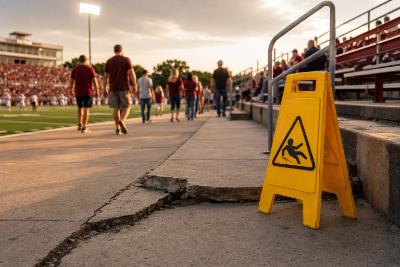
Football season can change how properties are used throughout El Paso. A stadium, school facility, restaurant, bar, parking lot, or event space may handle far more people than it does during normal operations. Temporary seating, vendor equipment, electrical cords, tents, barriers, signs, and crowd-control devices may also change normal walking routes.
A larger crowd does not make a property owner automatically responsible for an injury. It can make inspections, cleanup, lighting, maintenance, pedestrian routing, and crowd management more significant to the safety of guests.
Examples of conditions that may require attention include:
- Spills around concession stands or drink stations
• Water tracked into entrances or restrooms
• Damaged stairs, steps, ramps, or handrails
• Potholes, cracks, raised concrete, or uneven pavement
• Poorly lit walkways, stairwells, or parking areas
• Extension cords or temporary cables across pedestrian routes
• Loose mats, rugs, or temporary floor coverings
• Barricades, signs, equipment, or furniture placed in walking paths
• Unstable tents, tables, temporary seating, or vendor structures
• Congested gates, stairs, exits, or pickup areas
The key question is not simply whether you fell or were injured. The evidence must connect your injury to a condition or activity for which another party may be legally responsible.


Enrique Chavez
Texas Trial Attorney
Protecting Your Rights
What You May Need to Prove in a Texas Premises Liability Claim
Premises liability cases depend heavily on the facts. The duty owed to you can vary based on why you were on the property and your legal status while you were there.
If you were an invitee, a Texas premises liability claim commonly requires evidence that:
- A condition on the property created an unreasonable risk of harm
• The property owner or occupier knew or reasonably should have known about the condition
• The owner or occupier failed to use reasonable care to reduce or eliminate the risk
• The failure caused your injury and resulting damages
Actual knowledge may be shown through evidence that an employee, manager, contractor, or other responsible person knew about the hazard before you were injured.
Constructive knowledge can depend on whether the condition existed long enough that a reasonable inspection should have discovered it. The length of time a hazard existed can become a major issue in a slip and fall case.
For example, a drink spilled only moments before a fall may present a different legal question from a spill that remained near a concession area long enough for staff members to discover and address it.
For more information about claims involving unsafe walking conditions, visit:
https://chavezlawfirm.law/el-paso-slip-and-fall-lawyers/
– Steve Hendrix – Adriana Solis – Luis Amador – Maria Terrazas


Who Controlled the Area Where You Were Injured?
Football events often involve several organizations at the same location. The property owner may not operate the concession stand. A school or stadium may use outside vendors. A restaurant may hire a company to install temporary equipment. Security may be provided by a contractor. A parking lot may be owned by one entity but operated by another during an event.
Because several parties may be involved, the name on the building does not always identify the party responsible for the area where you were injured.
An investigation may examine:
- Property ownership records
• Lease or occupancy agreements
• Vendor and concession contracts
• Maintenance agreements
• Event plans
• Inspection and cleaning records
• Security contracts
• Staffing assignments
• Insurance information
• Photographs and surveillance recordings
Control can matter because a party generally must have a legally relevant connection to the property, condition, or activity before premises liability can attach.
Special Rules Can Apply to Public School and Government Property
High school football injuries require careful legal review when the event takes place on public school district property.
Texas Civil Practice and Remedies Code Section 101.051 generally provides that the Texas Tort Claims Act does not apply to a school or junior college district except as to motor vehicles. As a result, governmental immunity can bar many ordinary premises liability claims against a public school district unless another legal basis or waiver applies.
Different rules may apply when an injury involves city property, county property, or another governmental unit. Texas Civil Practice and Remedies Code Section 101.101 generally requires notice of a claim against a governmental unit under the Texas Tort Claims Act no later than six months after the incident, subject to statutory exceptions and other applicable notice provisions.
If your injury occurred at a public school stadium or another government-owned venue, the identity of the responsible entity and the applicable deadlines should be reviewed as early as possible.
Evidence Can Disappear Quickly After a Football Event
Temporary event conditions can change within minutes. A spill can be cleaned. A cable can be moved. A damaged mat can be removed. Temporary barriers can be taken down after the game. Surveillance recordings may also be deleted or overwritten under a venue’s normal retention practices.
Evidence matters. A temporary football-event hazard may disappear long before a claim is investigated. Preserving what you can may help show exactly what happened.
If your condition allows, consider taking these steps:
- Photograph or record the exact hazard and surrounding area
• Photograph lighting, warning signs, barriers, stairs, or walking routes
• Report the incident to a manager, event official, or property representative
• Ask whether an incident report was created
• Get names and contact information for witnesses
• Save your ticket, receipt, parking pass, or other proof that you were at the property
• Seek appropriate medical evaluation
• Keep medical bills and treatment records
• Save documents showing missed work or lost income
• Preserve clothing or shoes if they may become relevant
• Write down what happened while the details are still clear
These steps do not guarantee that a claim will succeed. They may help preserve evidence that can later become difficult to obtain.
How Comparative Responsibility Can Affect Your Texas Claim
A property owner, contractor, vendor, or insurer may argue that you were distracted, failed to follow a warning, entered a restricted area, or otherwise contributed to the incident.
Texas uses a proportionate responsibility system. Under Texas Civil Practice and Remedies Code Section 33.001, you generally cannot recover damages if your percentage of responsibility is greater than 50 percent. If your percentage of responsibility is 50 percent or less, Section 33.012 generally requires the amount of recoverable damages to be reduced by your percentage of responsibility.
Evidence can become especially valuable when responsibility is disputed. Photographs may show that a hazard was difficult to see. Witnesses may confirm that no warning was present. Video may show how guests were directed through the area before the incident.
What Damages May Be Available After a Premises Liability Injury?
If you establish liability, the damages available in your case will depend on the injuries and losses that you can prove.
Depending on the facts, damages may include compensation for:
- Past and future medical expenses
• Lost income
• Loss of earning capacity
• Physical pain
• Mental anguish
• Physical impairment
• Scarring
• Disfigurement
There is no preset value for a football-event injury claim. Medical evidence, the severity and duration of your injuries, work-loss documentation, future treatment needs, liability evidence, available insurance coverage, and any percentage of responsibility assigned to you can affect the value of a claim.
When a Football Event Injury May Involve Negligent Security
Not every football-related premises claim involves a slip or trip. Crowded parking areas, post-game gatherings, watch parties, restaurants, and late-night events may also raise security questions.
A negligent security claim can involve allegations that a property owner or occupier failed to take reasonable precautions against foreseeable criminal conduct. The analysis can involve prior criminal activity, the similarity and proximity of prior incidents, lighting, access control, security staffing, warnings, and the layout of the property.
Foreseeability is highly fact-specific. The occurrence of a crime on the property does not automatically establish negligent security.
For more information about this area of law, visit:
https://chavezlawfirm.law/el-paso-negligent-security-lawyers/
How Long Do You Have to File a Texas Premises Liability Lawsuit?
Texas Civil Practice and Remedies Code Section 16.003 generally requires a personal injury lawsuit to be filed no later than two years after the cause of action accrues.
Exceptions can change the deadline. Claims involving governmental entities can also involve notice requirements that arise much sooner than the general two-year filing period.
You should not rely on the general two-year period without evaluating the facts of your case. The identity of the defendant, the location of the incident, your age, the nature of the claim, and other circumstances can affect deadlines.
Delay can also make evidence harder to preserve. Event venues may clean or repair the area, replace equipment, remove temporary structures, change staff, or overwrite video before a lawsuit is filed.
What a Premises Liability Lawyer Can Do After a Football Event Injury
A premises liability lawyer can investigate who owned, occupied, maintained, operated, or controlled the location where you were injured.
Depending on the case, an investigation may include:
- Reviewing photographs and video
• Requesting surveillance recordings
• Obtaining incident reports
• Reviewing maintenance and inspection records
• Examining vendor, lease, or service agreements
• Identifying witnesses
• Reviewing security information
• Evaluating insurance coverage
• Determining whether governmental immunity or notice rules apply
• Evaluating comparative responsibility arguments
Legal counsel can also assess whether your case is better treated as premises liability, negligent activity, negligent security, or another personal injury theory. The legal classification can affect the elements that must be proven.
For information about the firm’s broader personal injury practice, visit:
https://chavezlawfirm.law/el-paso-personal-injury-lawyers/
Speak With an El Paso Premises Liability Lawyer
If you were injured at a football game, watch party, tailgate, restaurant, parking area, stadium, or another football-season event in El Paso, you may have questions about who was responsible and what evidence you need.
Chavez Law Firm can review the facts of your incident, identify potentially responsible parties, evaluate available evidence, and explain the legal options that may apply to your situation. The firm serves injured people in El Paso, Texas, and nearby areas.
Call Chavez Law Firm at (915) 995-5777 or visit:
https://chavezlawfirm.law/contact-us/
This article is for informational purposes only and is not legal advice. Consult an attorney about your specific situation.x

|
|
|